
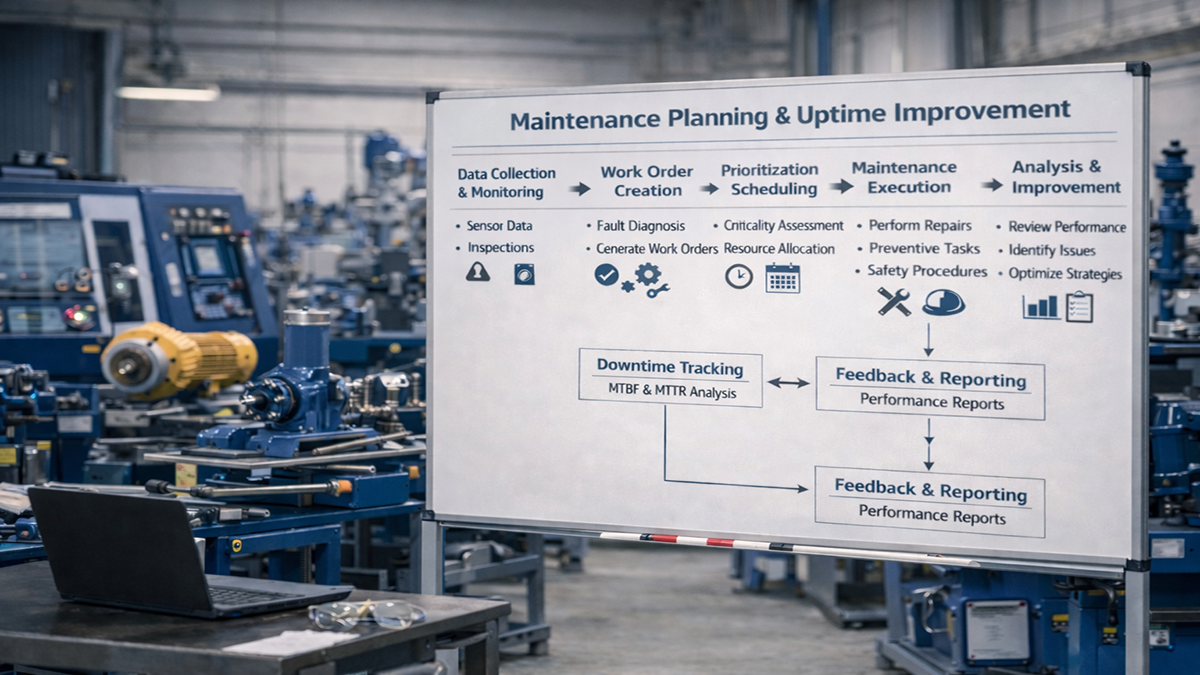
Unplanned downtime is one of the most expensive operational risks in processing plants. Beyond direct production loss, breakdowns often create secondary impacts such as product handling delays, sanitation schedule disruption, and quality deviations. In many facilities, the underlying issue is not only the machine fault itself, but also the absence of a structured workflow to detect, report, escalate, and close service actions consistently.
Why Downtime Persists in Otherwise Well-Equipped Plants
Plants often have capable machinery and maintenance teams, yet downtime continues due to repeated failure patterns that remain undocumented or unresolved at root cause level. Common contributors include incomplete service reporting, informal escalation via calls and messages, missing spare readiness, and lack of preventive schedules tied to real operating conditions.
A practical service workflow creates predictable steps for how a fault is logged, how it is categorized, who owns the next action, and how closure is validated. This does not require complex systems; it requires consistency and traceability.
Step 1: Standardize Incident Logging
Every breakdown or abnormal condition should be recorded using a consistent structure:
- Asset identification: machine name, module, line position, model.
- Symptom: what the operator observed, including alarms or stoppage type.
- Operating condition: batch size, shift details, product, sanitation cycle status.
- Immediate action taken: reset, cleaning, component swap, bypass.
Standard logging prevents loss of critical context and supports meaningful trend analysis later.
Step 2: Apply Clear Severity & Escalation Rules
Escalation discipline helps teams prioritize correctly. A simple severity rule-set is usually sufficient:
- Critical: line stop with safety or quality impact.
- High: performance reduction or repeated fault in a shift.
- Medium: abnormality requiring planned intervention.
- Low: cosmetic, advisory, or non-blocking improvement item.
When severity is defined, escalation pathways become predictable, reducing delays and confusion.
Step 3: Create a Closure Standard
Closing a service event should mean more than “machine started.” Closure should include:
- Root cause note: component failure, alignment issue, sensor drift, sanitation residue, etc.
- Corrective action: what was repaired or adjusted.
- Verification: run validation, quality check, temperature/flow check where applicable.
- Preventive recommendation: change frequency, spare addition, inspection point.
Closure discipline converts service events into learning and reduces recurrence.
Step 4: Tie Preventive Maintenance to Real Usage
Preventive schedules should reflect actual operating hours, product abrasiveness, wash cycles, and environment factors. Fixed schedules without condition awareness often result in either excessive maintenance (waste) or insufficient maintenance (risk). The best approach is to maintain baseline schedules and refine them using service history patterns.
Step 5: Maintain Spare Readiness for High-Failure Items
Downtime duration is frequently driven by spare availability rather than repair complexity. Plants should identify critical spares and maintain minimum stock based on lead time and failure rates. Typical high-impact items include sensors, belts, bearings, seals, contactors, and control components depending on the line type.
Conclusion
A practical service workflow is a low-cost, high-impact operational tool. When plants standardize reporting, enforce escalation clarity, close service events with root cause discipline, and align preventive routines with real usage, downtime reduces not by chance but by design. Consistent documentation turns maintenance from reactive repair into managed reliability.